
There’s a quote seen online often from George R.R. Martin — or more likely it’s just my algorithm serving it up to me — that says a man who doesn’t read only lives one life while one who does lives a thousand lives before he dies. Especially as I wake up to new horrors each day in this world, I wonder if that quote feels as relevant in 2026. A thousand lives? Stressful. But maybe the more important part of what Martin means here is that we gather more of the human experience. For all of our daily work to train the perfectly curated experience through likes and swipes, books more often take us places unexpected. As is our annual tradition, The Contributor brings you our annual list of books that can take you somewhere the algorithm might not allow.

The Flourishing Community: A Story of Hope for America’s Distressed Places
By Brad Ketch
I like reading books from authors I met in a meeting. Brad Ketch is all about community building and has written a handbook of how to go into a poor neighborhood that has been seemingly overlooked. The premise is that no one will come to save these struggling communities. The saving will have to happen from within, starting with asset mapping and lifting up local leaders. This is the story of Rockwood, Ore., and how its resident leaders organized to work on building a flourishing community. JUDITH TACKETT

There Is No Place For Us: Working and Homeless in America
By Brian Goldstone
In his Pulitzer-prize winning book, Goldstone reminds us that homelessness often does not look like tents or sidewalk-sprawled sleeping bags. Approachable and heart wrenching, There Is No Place For Us weaves the very real stories of working Atlanta families living in their cars, motels and crowded apartments with the history and politics that got us to this moment not only in Atlanta but across America. INDIA PUNGARCHER

The Correspondent
By Virginia Evans
This was my absolute favorite work of fiction I’ve read in the last 12 months. Evans takes us into the world of Sybil Van Antwerp, a cantankerous protagonist who generally communicates with the outside world via letter writing despite living in the present day. Readers follow Van Antwerp’s life through her back-and-forth relationships on paper and as she progressively loses her sight. The story highlights the value of written communication, shared secrets and the opportunity to forgive oneself. EMILY WEST

We Might Just Make it After All
By Elyce Arons
I remember reading about when Kate Spade died by suicide. What I didn’t expect was to learn all about her life through her best friend, Elyce Arons, years later in her memoir about their friendship. Told sequentially, Arons takes us back to their first meeting in college and to the moments they decided to launch their worldwide brand, Kate Spade. The memoir — which is raw and vivid — makes us feel like Arons and Spade are our best friends, too. EMILY WEST

Unspeakable Things
By Brooke Nevils
I watched Matt Lauer my entire childhood growing up, with my parents avid watchers of the TODAY Show. But Nevils shows a different side of the TV star public persona in her tell-all memoir that demonstrates how sexual assault can shatter a soul. Nevils — who came forward as a survivor of sexual assault at Lauer’s hand — takes readers through her life both before and after the assault that changed the course of her life. This was a memoir I couldn’t put down, no matter how hard and chilling it was to bear witness to that level of trauma. Nevils shows what it’s like to be a true journalist, even when it comes to reporting on herself. EMILY WEST

All Fours
By Miranda July
When I decided to listen to this audiobook, I was under the very wrong impression that July’s book was a memoir. It somehow made the idea of a woman taking off on a cross-country trip and only making it a couple towns over to do her own thing seem even more powerful. “Do her own thing,” goes a little further than one might expect. And needless to say that while July does incorporate some life experiences into her work, it was indeed not a memoir. It’s still worth a read even if you are a more informed reader than me. AMANDA HAGGARD

The Lion Tracker’s Guide to Life
By Boyd Varty
The Lion Tracker’s Guide to Life is a beautifully written blend of memoir and life philosophy, following a real-life lion tracking expedition in the South African wilderness. As Boyd Varty tracks a lion alongside mentors from childhood who are master trackers, he reveals how the ancient art of tracking becomes a powerful metaphor for navigating our own lives, stressing intuition, and reconnecting with our “wild” inner selves. We don’t know where we are going, but it certainly helps to know how to get there. The audio book is wonderful, and is read by the author. CATHY JENNINGS

Martyr!
By Kaveh Akbar
This book is one a reader could absolutely fly through if they’re not careful enough to slow down and take it all in. The story follows a young, Iranian recovering addict with a complex family history through his deep interest in people who want to die for a “purpose.” After a series of discoveries about his own history and he attempts to write a novel about modern martyrs, the man thinks to himself that there is as much to make of being here as there is to make of not being here. Akbar’s prose about death and dying makes you want to pause, and you should because this book is worth savoring. AMANDA HAGGARD
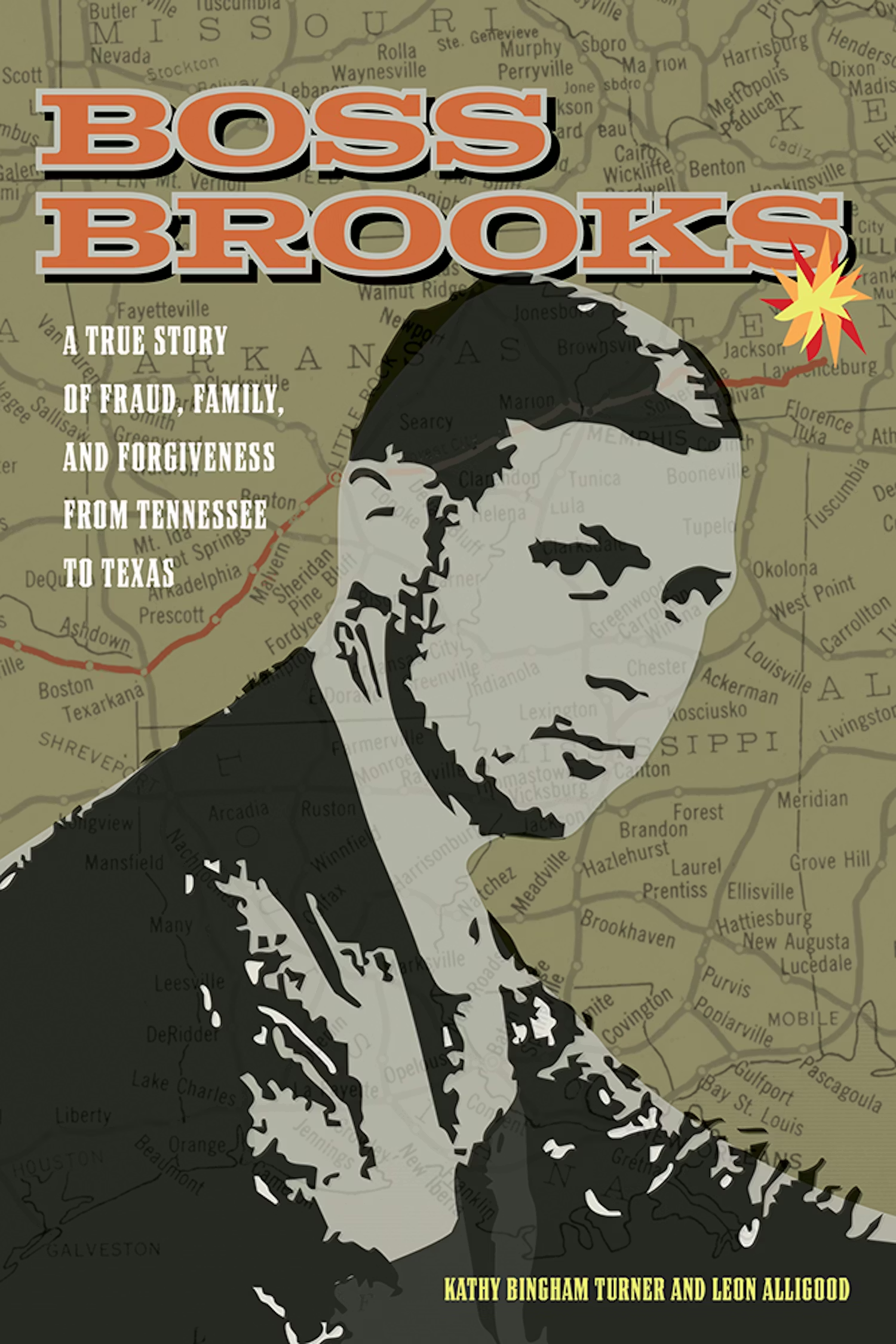
Boss Brooks: A True Story of Fraud, Family, and Forgiveness from Tennessee to Texas
By Leon Alligood and Kathy Bingham Turner
If you’ve ever felt you had a less than conventional family, you could grab a coffee to catch up with one Kathy Bingham Turner. Or you could read the book written by Turner and longtime local journalist Leon Alligood that outlines Turner’s grandfather’s tale of a faked death. Turner’s grandfather had been the subject of local lore for years, and she and Alligood dig in on what actually happened to him. It’s a lovely story of how a family manages after one member changes their history. AMANDA HAGGARD

The Golden Ass
by Apuleius
Apuleius, born under Roman rule in what is now Algeria, and writing for a Roman audience, bequeaths to us his comic masterpiece The Golden Ass: a rollicking, off-color, satirical proto-novel that feels surreally modern. In it, his alter ego, a young man named Lucius, is transformed from a man into a donkey by his reckless new girlfriend, who dabbles in black magic. We travel with Lucius-as-donkey for a year as he desperately tries to get his mouth on some roses, the antidote that will turn him back into a man. As he passes from owner to owner, increasingly imperiled on his unwitting adventure, a series of hijinks ensue. Can a text from the second century really be a fun beach read? Yes. It can. LAURA BIRDSALL

Songs of No Provenance
By Lydi Conklin
I’ll be honest, I love everything I’ve read by Lydi Conklin. The way they approach narrative is refreshing. There are plot twists in their stories that don’t feel trite. In Songs of No Provenance, Conklin explores discomfort, self-awareness and shame in ways that most authors would shy away from. The main character reckons with a pee fetish (somehowI promise that’s not a spoiler) as well as a career in music that leaves them confused and searching for who they actually are. Conklin’s not one for a traditional moral arc so if you can’t handle a complex character, this one may not be for you. AMANDA HAGGARD

Living in the Present with John Prine
By Tom Piazza
In a review for BookPage, I wrote that there would never be a memoir by John Prine, but that this book was the next best thing. The beloved, Nashville-based singer-songwriter died in 2020 from complications of COVID-19 right as New Orleans-based music writer and novelist Tom Piazza had started interviewing him for a memoir. Piazza took his first couple of interviews and notes from their friendship and wrote this. If you’ve ever cried, laughed or swayed to a Prine song, this one is a must. AMANDA HAGGARD

Little Weirds
By Jenny Slate
Anyone close to me knows when I describe someone I’ve met as a “true weirdo,” that it’s meant with a deep love and admiration. I’ve never met Jenny Slate, who folks might remember as Mona Lisa from Parks and Rec, and real ones would know as Marcel the Shell with Shoes On, but I’m certain she’s a true weirdo. Her book of essays Little Weirds proves such. She reads the audiobook, which is part poetry, part stream of consciousness, part ramblings. And it’s all very delightfully weird. AMANDA HAGGARD

Positive Obsession: The Life and Times of Octavia E. Butler
By Susan M. Morris
As I read this biography of science fiction author Octavia E. Butler, who, as genius as she was, struggled to pay her bills and settle into life well into her adulthood, I found myself thinking about all the incredible writers and artists I’ve known who’ve lived on the streets. As Butler studied life and wrote about gender, race, violence and climate change via tales of science fiction, she often wondered where her next paycheck was coming from. Despite her struggles, she wrote at libraries almost religiously like so many writers on the streets I’ve known. And she also passed at the young age of 58, much too soon. There’s so much more there to gather from this book, but if anything, you’ll learn what financial struggles can do to an otherwise brilliant person. AMANDA HAGGARD

The Upanishads
Translated by Juan Mascaró
It was nearly 100 years ago when poet and scholar Juan Mascaró first set about his translation of the Upanishads. English was not his native tongue, which perhaps accounts for the striking alchemy of his translation from the Sanskrit. This small volume of spiritual treatises, composed between 800 and 400 B.C., are rendered here in achingly lucid verse. Mascaró’s introduction itself stands alone as a joyful and meticulous treatise on the divinity that animates our shared culture. “I go to the Imperishable Treasure,” he incants. “By his grace, by his grace, by his grace.” LAURA BIRDSALL

The Feminist and the Sex Offender: Confronting Sexual Harm, Ending State Violence
By Judith Levine and Erica Meiners
Since its inception in the 1990s, the sex offender registry has been used to track the movements of those convicted of sexually-based offenses not only for the length of their sentence, but for their lifetime. While not excusing sexually-based offenses or demonizing those who are convicted of them, The Feminist and the Sex Offender: Confronting Sexual Harm, Ending State Violence, holds this tension and offers a path forward that honors individuals and sexual liberation, upholds accountability without buying into mass incarceration, and allows for alternatives which keep everyone safe. If you have ever been curious about how to separate the individual from the conviction, particularly as it pertains to this subset of offenses, and how to live in the gray area in a society that swings from ignorance to over-correction, this is worth the read. LINDSEY LONGORIA

Arcadia
by Tom Stoppard
Tom Stoppard, who took his final bow late last year, leaves behind so many heady, dreamy plays that it’s hard to pick just one. While it’s tempting to suggest everyone just start with Rosencrantz and Guildenstern are Dead, his iconic, surrealist tragicomedy that would have tickled Shakespeare himself, I offer one of his quieter plays here. Arcadia, first staged in 1993, bears the classic Stoppard hallmark – dialogue that builds a monument to the misheard and misunderstood, yielding in the end something transcendent. But at its heart is a precise, perfectly rendered romance unfolding across centuries at a country estate. Like all Stoppard plays, Arcadia stands alone as a text and can be easily consumed in print on a lazy afternoon. LAURA BIRDSALL

Nonviolent: A Memoir of Resistance, Agitation and Love
By Reverend James Lawson Jr. and Emily Yellin
Most of us like to think we are good people. But we’re not in the league of the Rev. James Lawson Jr. I envy the readers who know little about Lawson, an unsung hero of the civil rights movement. His son and co-author both call him the most moral man they knew. When you hear his story, it’s tough to disagree. Nonviolence is not boring. In this life story, it is gripping, fascinating and complex. JIM PATTERSON

The Tao of Fully Feeling: Harvesting Forgiveness out of Blame
by Pete Walker
At 47, this book found me at the right time. Growing up in the South, I learned how to work, perform, joke and push through, but not always how to feel. Pete Walker writes with a kind of hard-earned compassion that made me feel less alone and less defective for struggling with the full spectrum of emotion. The Tao of Fully Feeling helped me understand how much emotional life can get buried under survival, shame, and performance. An old book, but still deeply relevant to all of us who were taught to stay composed instead of staying connected to themselves. WILL CONNELLY